Introduction: Thunderbird to Outlook Migration (2026)
Moving from Thunderbird to Outlook is common when you need Microsoft 365 integration, shared mailboxes, or PST-based archiving. This guide focuses on Thunderbird to Outlook migration methods that work in 2026 and explains what to choose for Local Folders, PST output, and mailbox moves.
Quick answer (2026)
- If your mail is already IMAP/Exchange, just add the same account to Outlook (no conversion).
- If you have Thunderbird Local Folders/POP, use EML export for small folders or a converter for large mailboxes and best metadata retention.
If you need a PST, Classic Outlook is still the most reliable path. If you only need mail in a Microsoft 365 or Outlook.com mailbox, an IMAP bridge can work.
Related guides:Import MBOX to Outlook, Thunderbird to PST, EML to PST in Outlook.
Pick your scenario (fast decision)
First decide: are your emails on an IMAP/Exchange server, or in Thunderbird Local Folders (stored on this PC).
- Mail is already on IMAP/Exchange (Gmail / Microsoft 365 / Yahoo IMAP): use Method 0 (add the same account to Outlook; no conversion).
- Mail is in Local Folders / POP (offline mail on this PC): use Method 1 (IMAP upload bridge) or Method 2 (EML) or a converter (best for large mailboxes / hierarchy).
- Need a PST file (archive/backup/migration file): use Classic Outlook for Import/Export wizard workflows.
New Outlook vs Classic Outlook (2026 reality)
- Classic Outlook (Windows desktop): Best for the traditional Import/Export wizard (PST import/export and legacy workflows).
- New Outlook (Windows): You can open a PST and move/copy mail and folders. If you need the classic Import/Export wizard workflow (or full bulk import behaviors), use Classic Outlook.
Tip: In some setups, opening a PST in the new Outlook may require Classic Outlook installed (and matching 32-bit vs 64-bit).
Method comparison (fast decision)
| Method | Works for Local Folders... | Preserves folder hierarchy... | Needs Outlook app... | Best for mailbox size |
| IMAP upload bridge (Gmail/Outlook.com) | Yes (indirectly - copy Local Folders/POP mail into an IMAP folder first) | Partial (server folders/labels may map differently) | Yes (Outlook mailbox) | Small/medium (limited by Gmail storage + upload time) |
| EML export + drag-drop | Yes | No (manual recreation) | Yes (Classic Outlook) | Small only |
| SysCurve Thunderbird to Outlook Converter | Yes | Yes | Yes (Classic Outlook installed) | Medium/large |
What usually transfers vs what may not
- Usually transfers: folder names (converter/IMAP), attachments, subject/body, sender/recipient, dates (IMAP best), most read/unread flags (IMAP often).
- May change: labels vs folders (Gmail), categories/flags, exact read/unread consistency (manual), and some metadata when using EML drag-drop.
Note: If you need a perfect archive with folder hierarchy + metadata intact, use Classic Outlook + PST (converter path).
Common mistakes (avoid these)
- Copying from Gmail “All Mail”: this often creates duplicates because labels map to multiple folders.
- Dragging 10,000+ EML files at once: Outlook can freeze or skip items; import smaller batches.
- Expecting Local Folders to sync automatically: Local Folders are stored on disk - you must export them (EML) or copy them into an IMAP folder first (IMAP upload bridge).
Estimated time by mailbox size (rough)
| Size | Manual (IMAP/EML) | Converter | Notes |
| ~1 GB | A few hours | Faster | IMAP depends on upload speed + throttling |
| ~5 GB | Many hours to a day | Hours | EML batch size: 50-200 |
| ~20 GB+ | Can take days | Hours (disk I/O bound) | Converter is disk I/O bound |
Note: Actual time varies by network speed, disk I/O, and folder count.
Thunderbird Local Folders (what will not sync automatically)
Thunderbird Local Folders are stored only on this PC (not on the mail server), so they will not sync automatically to Outlook. To move Local Folders, export them (EML) or copy them into an IMAP mailbox first (IMAP upload bridge), or use a converter for best hierarchy + metadata.
Profile path (Windows): %APPDATA%\Thunderbird\Profiles\ (look for a folder like xxxxxxxx.default-release).
Profile path (macOS): ~/Library/Thunderbird/Profiles/
Profile path (Linux): ~/.thunderbird/ (Flatpak: ~/.var/app/org.mozilla.Thunderbird/.thunderbird/)
Local Folders path: Mail\Local Folders inside the profile.
Tip: .msf files are indexes; the real mailbox data is usually the file with no extension (MBOX). For Maildir profiles, each message is stored as a separate file.
Mozilla note: Thunderbird can store mail as Mbox (many messages stored in a single mailbox file per folder) or Maildir (each message stored as a separate file). This can affect how exports/tools behave.
Related guides: Import MBOX into Outlook, Thunderbird to PST, EML to PST in Outlook.
Why move to Outlook
Outlook is tightly integrated with Microsoft 365, shared calendars, Teams, and compliance controls. Thunderbird is a solid standalone client, but Outlook is often the better fit in Microsoft 365 environments.
- Centralized mailbox and calendar collaboration in Microsoft 365.
- PST-based archiving and compliance workflows.
- Native integration with Office apps and Teams.
Your Pre-Migration Blueprint: A 4-Step Success Checklist
A smooth migration hinges on good preparation. Rushing this process is the primary cause of errors and data loss. Following this 4-step checklist will ensure a clean, trouble-free transition.
Step 1: Data Safeguarding: Creating a Failsafe Backup
Before any migration attempt, creating a complete backup of the Thunderbird profile is strongly recommended. This backup is a safety net, ensuring that no matter what happens during the transfer, the original data remains intact and recoverable.
The Thunderbird profile contains all emails, contacts, settings, and add-ons. To locate it:
- Open Thunderbird.
- Click the menu button (three-line menu), then navigate to Help > More Troubleshooting Information.
- In the Application Basics section, find the Profile Directory or Profile Folder entry and click the Open Folder button.
- This will open the profile folder in the system’s file explorer. It will have a name like xxxxxxxx.default-release.
- Close Thunderbird completely.
- Go up one level in the file explorer to see the Profiles folder. Copy this entire folder to a safe, external location, such as a USB drive or a cloud storage service.
Note: Menu names can vary slightly by version.
Step 2: Mailbox Hygiene: Streamlining for Efficiency
A smaller mailbox migrates faster and with fewer errors. For better efficiency, quickly clean up your Thunderbird mailbox:
- Delete any old, unnecessary emails.
- Empty the Trash and Junk folders.
- Review large attachments and save them externally if they are no longer needed within the email itself.
- Archive very old emails that are needed for records but not for daily access.
Step 3: System & Version Check
Ensure Thunderbird and Microsoft Outlook are fully updated to avoid compatibility errors. Use Classic Outlook for PST import/export (see the New Outlook vs Classic box above).
Step 4: Folder Structure Audit
Briefly review your folder and sub-folder hierarchy in Thunderbird. Manual migration methods often fail to preserve this structure. Knowing your layout beforehand will make it much easier to reorganize your emails in Outlook if necessary.
Manual Migration Pathways
For users with smaller mailboxes or those who wish to avoid paid software, manual methods offer a free alternative, but they can be time-consuming and error-prone, especially for large mailboxes. This section details the two most common manual methods with full transparency regarding their real limitations.
Method 0: If your mail is already IMAP/Exchange, just add the same account to Outlook
If Thunderbird is only viewing server mail (Gmail, Microsoft 365, Yahoo), no conversion is needed. Add the same account in Outlook and let it sync.
Use Method 0 when your mail already lives on a server (Microsoft 365/Exchange, Gmail, Yahoo IMAP). You’re just adding the same account to Outlook.
Use Method 1 only when your mail is offline (Thunderbird Local Folders or POP) and must be uploaded somewhere first.
Method 1: The IMAP Bridge (Using a Gmail Intermediary)
This popular manual method leverages a cloud-based email account, most commonly Gmail, to act as a bridge between Thunderbird and Outlook. The process involves two main phases: first, you upload your Thunderbird emails to the Gmail server, and second, you download those emails from the server into Outlook. Essentially, Gmail serves as a temporary hub for the data transfer.
OAuth-first (2026): Sign in with Google
Google recommends OAuth (“Sign in with Google”) for IMAP access. If the Google sign-in window appears, use your normal Gmail password.
App password (only if prompted): If Thunderbird or Outlook shows a basic password box or keeps prompting, generate an App Password. App passwords require 2-Step Verification and may not be available for some accounts or security settings.
Step-by-Step IMAP Migration (OAuth or App Password)
Step 1: Gmail IMAP status (2026)
Starting January 2025, Google says the IMAP enable/disable toggle is no longer available for many users - IMAP is on by default. Gmail enforces IMAP connection limits, so avoid signing in on too many devices/apps at once.
If you still see IMAP settings: Gmail -> Settings -> See all settings -> Forwarding and POP/IMAP -> leave IMAP enabled (if shown).
If you don’t see the toggle: continue - that’s expected.
Step 2: Configure Gmail in Thunderbird and upload Thunderbird mail to Gmail
1. Start Mozilla Thunderbird.

2. Go to Tools and select Thunderbird Options

3. Click on the Account setting

4. Click on Account actions

5. Select add mail account option

6. Enter a name, the Gmail address, and in the password field, use “Sign in with Google” if prompted; if you see a password box, paste the 16-digit App Password and click Continue.
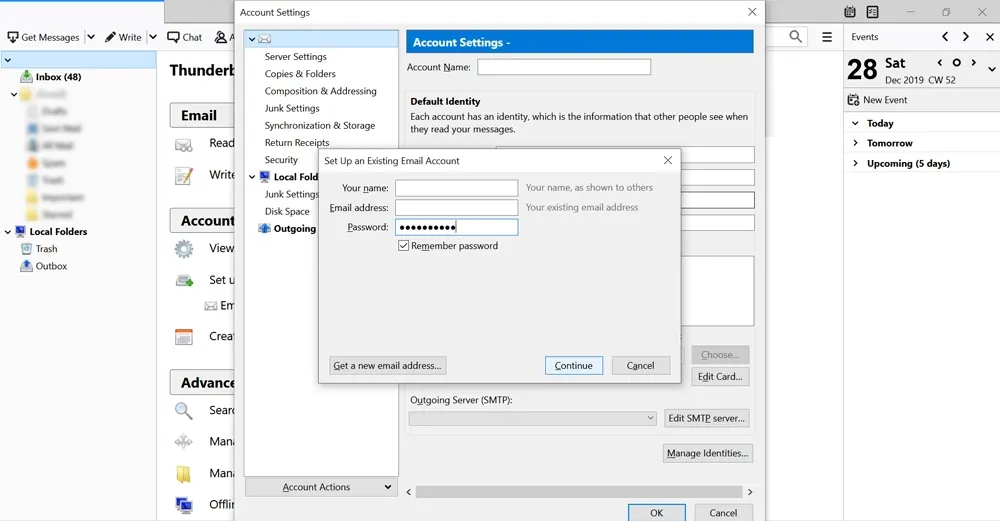
7. Select IMAP (remote folders) and click on Done

Step 3: Upload Thunderbird Emails to Gmail
Rule: Create one Gmail folder like “TB-Migration” and copy mail into it (do NOT copy from All Mail). Start folder-by-folder for cleaner results.
1. In Thunderbird’s folder pane on the left, find the newly configured Gmail account.
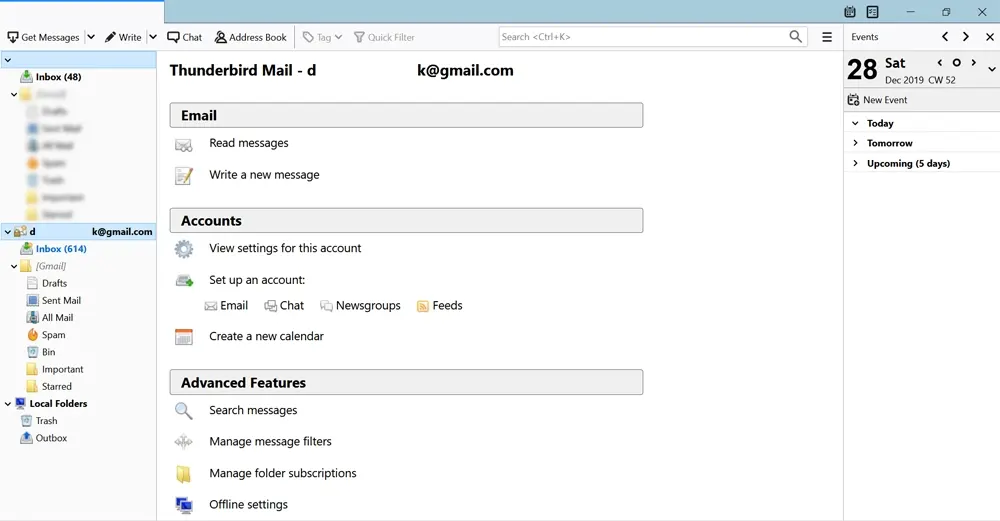
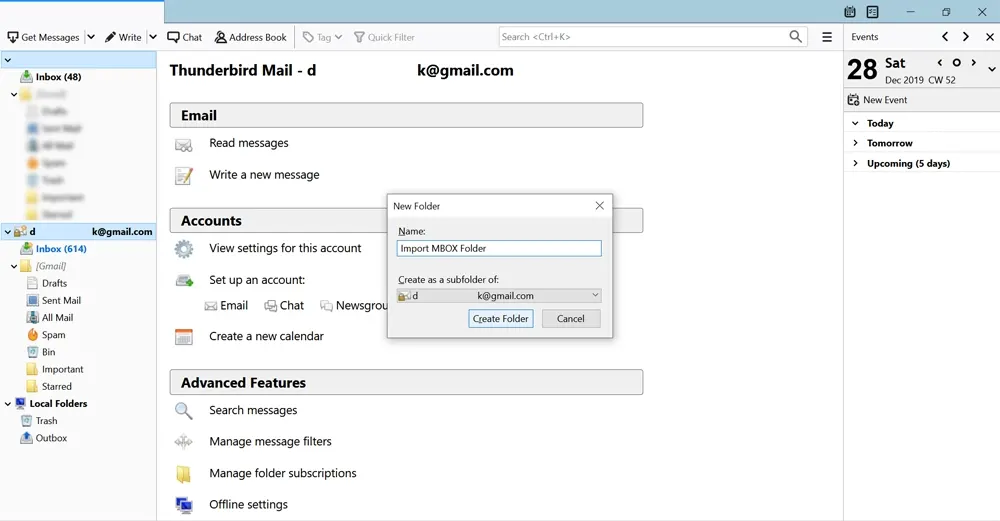
2. Right-click on Gmail account and create a new folder

3. Provide a name and click on the create folder button
4. Select your Thunderbird account and press Ctrl+A to select all emails
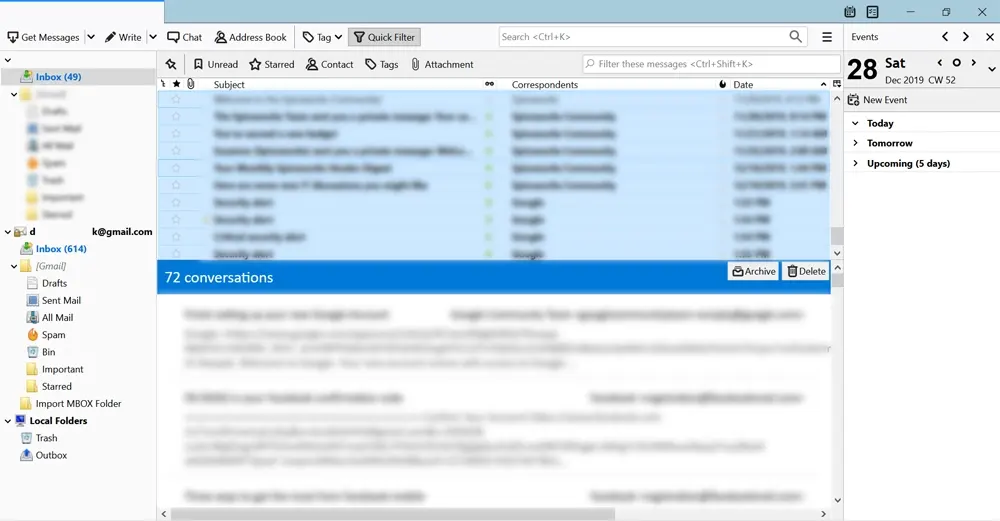
5. Right-click and select Copy
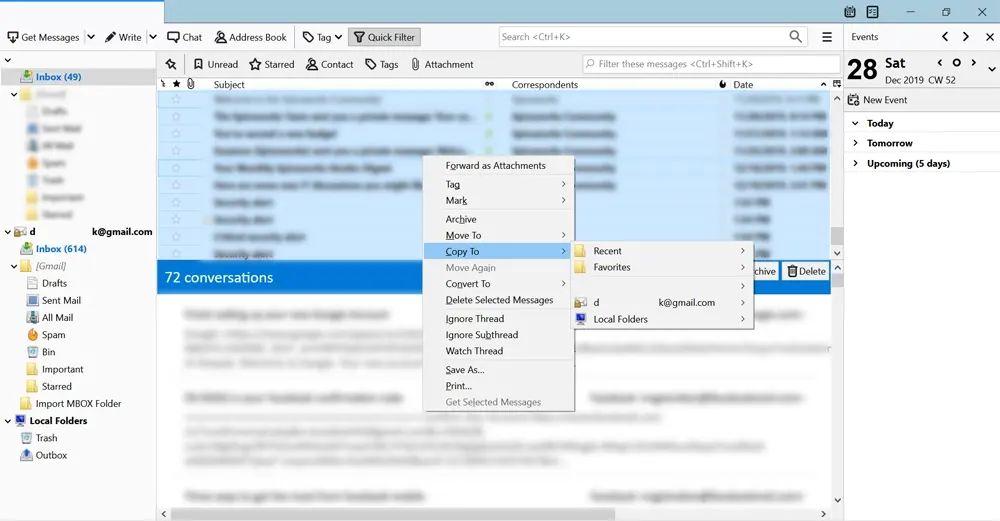
6. Select Gmail address and select the folder you just created

7. Check your Gmail folder

8. Go to your Gmail account and check the folder
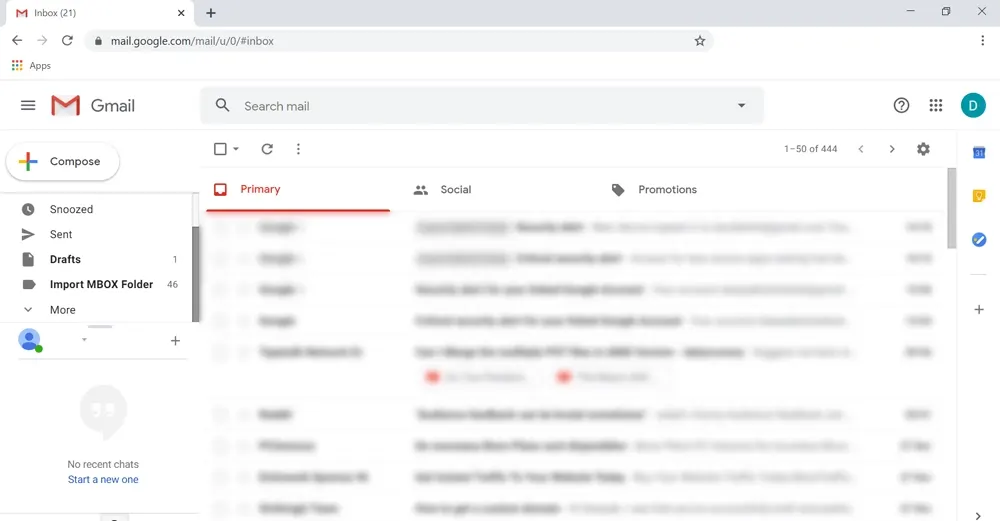
9. Click on the folder to verify

Step 4: Configure Gmail in Outlook and Sync
1. Launch MS Outlook.

2. Click on the File option.

3. Click on Account Settings and select Account settings.
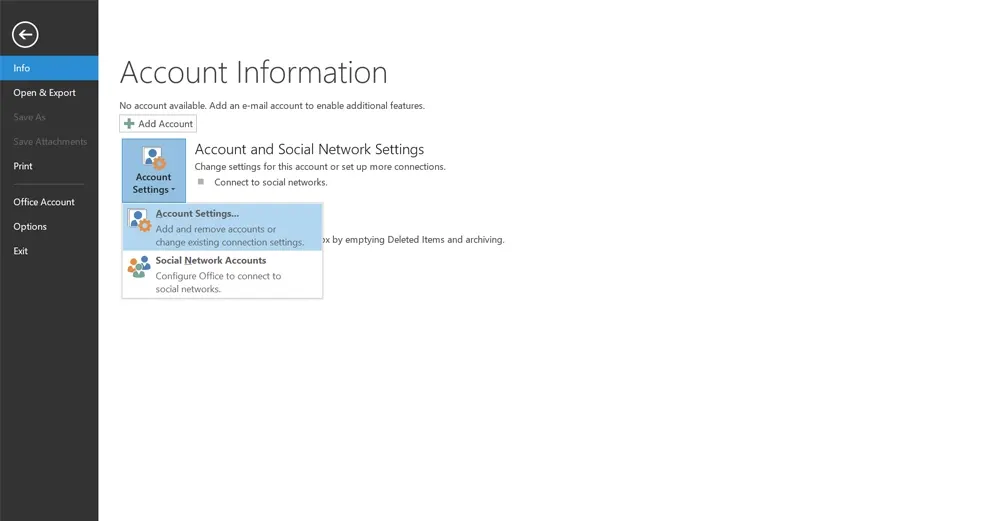
4. From the email tab, click on New.

5. From the add account window, provide your name and Gmail address. If a Google sign-in window appears, use Sign in with Google. If you see a password box, enter the 16-digit App Password and click Next.

6. After validation, you will get a successful screen. Click on the Finish button.
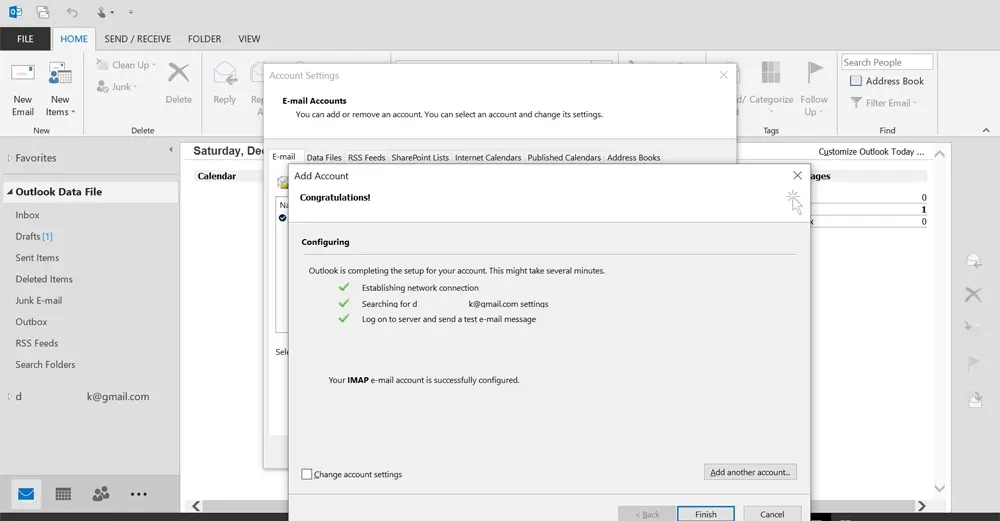
7. Close Account settings window
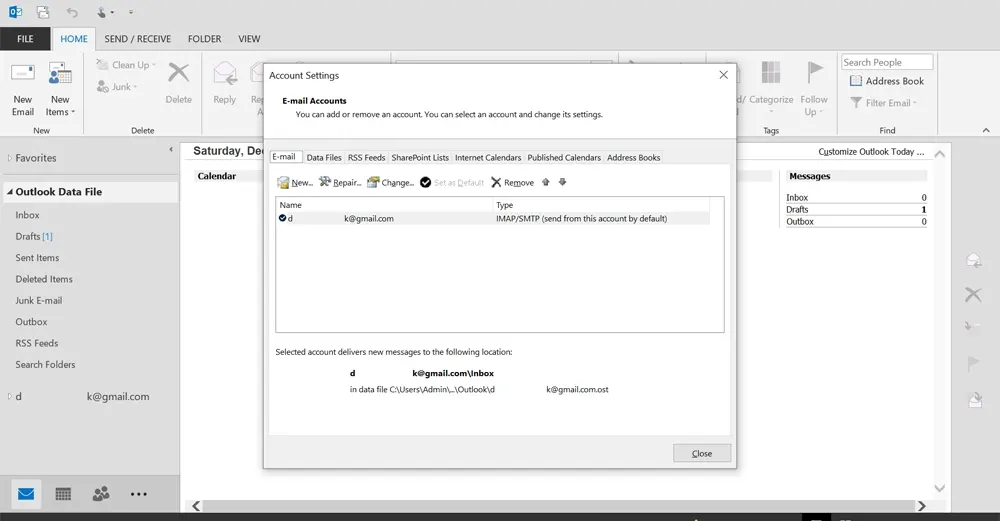
8. Go to the left pane and click on Gmail address to view the mails.

9. Congratulations! You successfully migrate Thunderbird to Outlook.
Privacy / compliance note
The IMAP bridge uploads your mail to a third-party server (Gmail). If data is sensitive or regulated, use offline conversion instead.
Limitations of the IMAP Method
- Slow sync: large mailboxes can take hours/days (upload + download).
- Storage limits: free Gmail has 15 GB total storage (Drive + Gmail).
- Throttling/connection caps: IMAP limits can cause temporary errors.
- Folder mapping differences: labels vs folders can change structure.
- Duplicate risk: copying from All Mail can create duplicates.
- Local Folders will not sync automatically: you must copy them into an IMAP folder first or export to EML.
- Privacy: mail is uploaded to a third-party server (not ideal for regulated data).
Duplicate reduction tip (Gmail)
Hide “All Mail” from IMAP or migrate folder-by-folder into a single Gmail folder before syncing to reduce duplicates.
Verification checklist (IMAP):
- Compare folder count and item count in Gmail vs Outlook.
- Spot-check 10 emails for attachments, dates, and read/unread status.
- Check 2-3 nested folders for hierarchy and duplicates.
Method 2: The Drag-and-Drop (EML Export/Import)
This method avoids using an intermediary server and instead involves saving emails to a local format (.eml) that Outlook can understand.
Exporting from Thunderbird as EML Files
Best (bulk): ImportExportTools NG
- Install ImportExportTools NG.
- Right-click the Thunderbird folder -> ImportExportTools NG -> Export all messages -> EML format.
- Export folder-by-folder (keeps hierarchy on disk and makes Outlook import manageable).
Small batches only (no add-on): Use “Save As” only for a few emails at a time (not thousands).
Importing EML Files into Outlook
- Open Microsoft Outlook.
- In the folder pane on the left, right-click on the name of the Outlook account (e.g., your.name@outlook.com) and select New Folder...
- Give the new folder a name, for example, “Imported from Thunderbird,“ and press Enter.
- Arrange the windows on the screen so that both the Outlook window and the “EML Export” folder from Phase 1 are visible.
- Click inside the “EML Export” folder and select all the .eml files (Ctrl+A).
- Click and drag the selected .eml files from the folder and drop them directly onto the “Imported from Thunderbird” folder in the Outlook pane.
- Outlook will begin importing the messages.
Tip: Drag-drop in small batches (50-200 EML at a time). Wait until Outlook finishes processing before the next batch.
Tip: Turn off Outlook’s reading pane during drag-drop (reduces freezes) and wait for indexing to finish.
Limitations of the Drag-and-Drop Method
- Least reliable for metadata: If you care about original dates/read status, EML drag-drop is the least reliable method; use it only for small folders.
- Extremely Time-Consuming: This method is only practical for a very small number of emails. For large mailboxes, it is incredibly tedious and inefficient.
- Application Freezing: Both Thunderbird and Outlook are prone to freezing or crashing when attempting to drag and drop thousands of files at once.
- Loss of Metadata: This method has a high risk of altering or losing critical email metadata, such as the original sent/received dates and times, and read/unread status.
- No Folder Structure: This technique does not transfer the folder hierarchy. It only moves the emails themselves, requiring complete manual reorganization in Outlook.
Verification checklist (EML):
- Compare item count in the Outlook target folder.
- Spot-check 10 emails for attachments and HTML formatting.
- Verify sent/received dates and read/unread status on sample items.
Tool-based method (best for large Local Folders)
If you have large Local Folders/POP mail or you must preserve folder hierarchy + metadata, a converter is usually the most consistent option.
Why a tool reduces risk for large mailboxes
- Speed and Efficiency: They can process entire mailboxes, regardless of size, in a fraction of the time it would take manually.
- Data Integrity: They are designed to preserve key elements of an email: headers, timestamps, read/unread status, formatting, and attachments.
- Hierarchy Preservation: The original folder and sub-folder structure from Thunderbird is preserved in the resulting Outlook file, reducing manual reorganization.
- Simplicity: They replace complex, multi-stage processes with a simple, wizard-based interface that requires no technical expertise in server settings or file formats.
A Complete Walkthrough: Migrating with the SysCurve Thunderbird to Outlook Converter
The SysCurve Thunderbird to Outlook Converter is a powerful tool that automates and simplifies the entire migration process. It directly converts Thunderbird’s MBOX files into Outlook-compatible PST files, ensuring a seamless and accurate transfer. One of its standout features is the ability to automatically detect the configured Thunderbird profile on the system, removing any guesswork for the user.
1. Download the SysCurve Thunderbird to Outlook Converter from the official website. Install the application on the Windows computer where Thunderbird is installed.
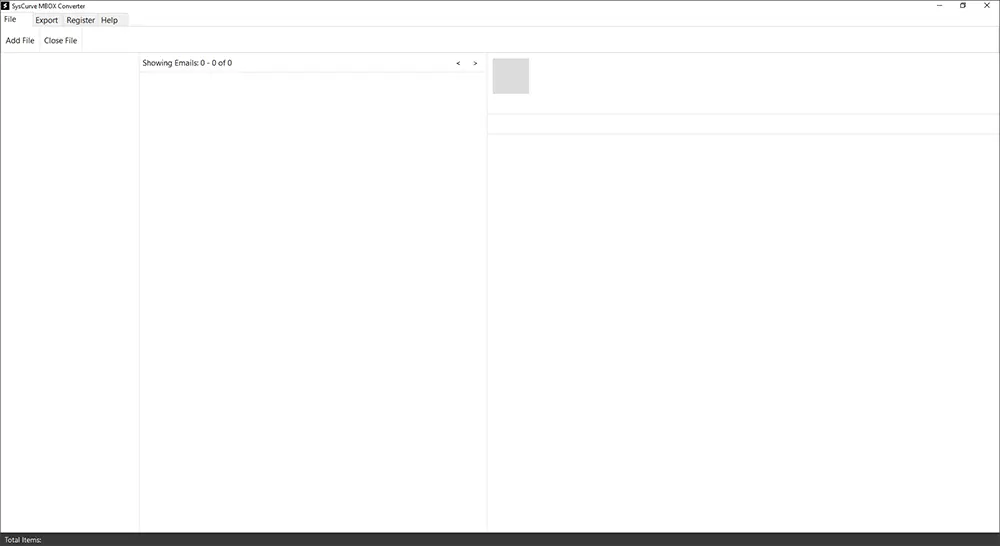
2. Launch the application and click the ‘Add File’ option.
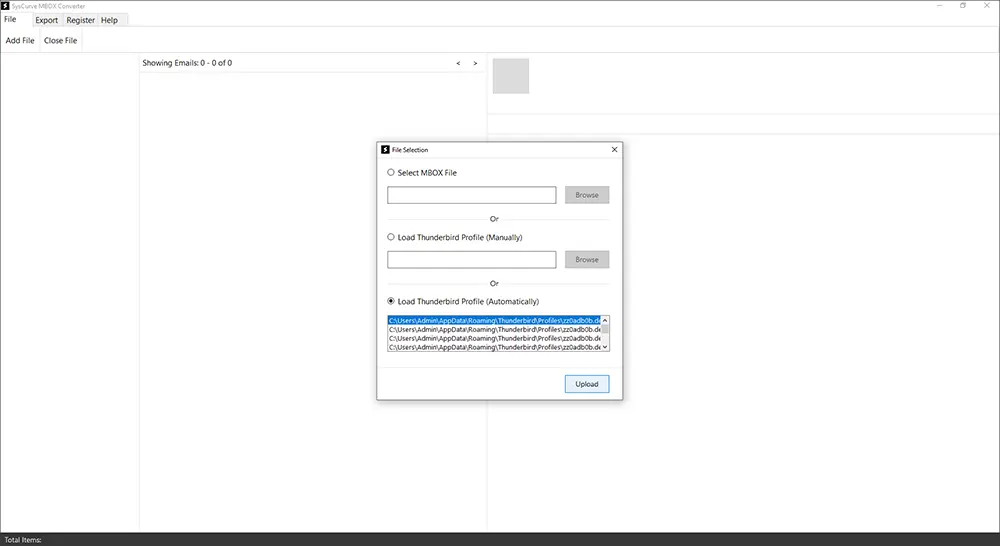
3. Choose the ‘Load Thunderbird Profile’ option, then click the ‘Upload’ button.
4. Once loading completes, select a folder to generate a preview. You can select any email to view detailed information.
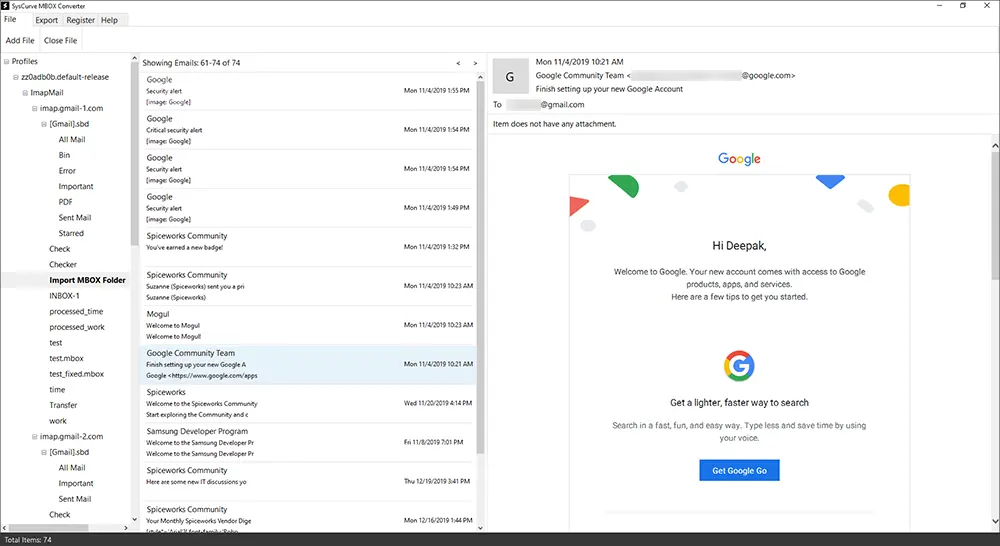
5. Click the ‘Export’ option, choose the folders you want to export, and select PST as the export format.
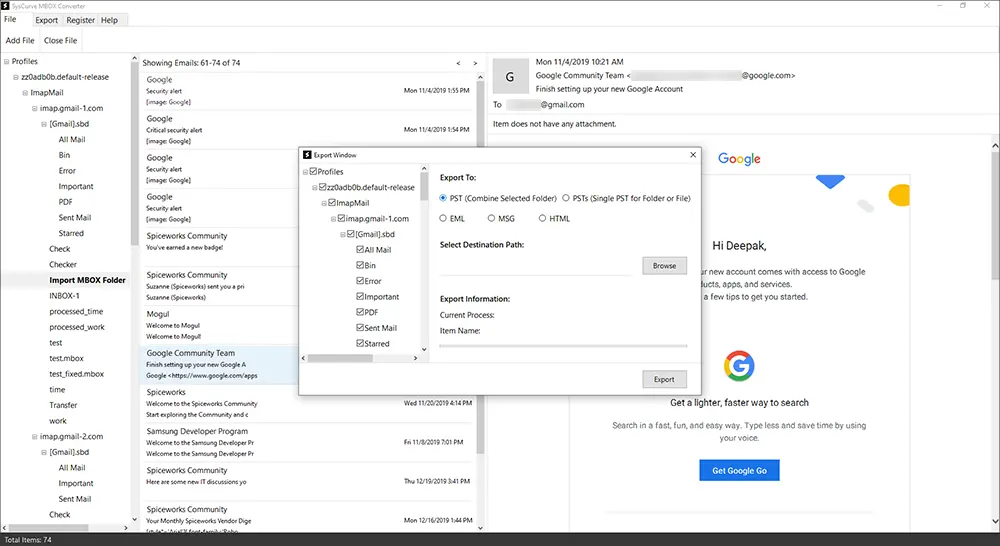
6. Click the ‘Browse’ button and specify the path where you want the PST file saved.
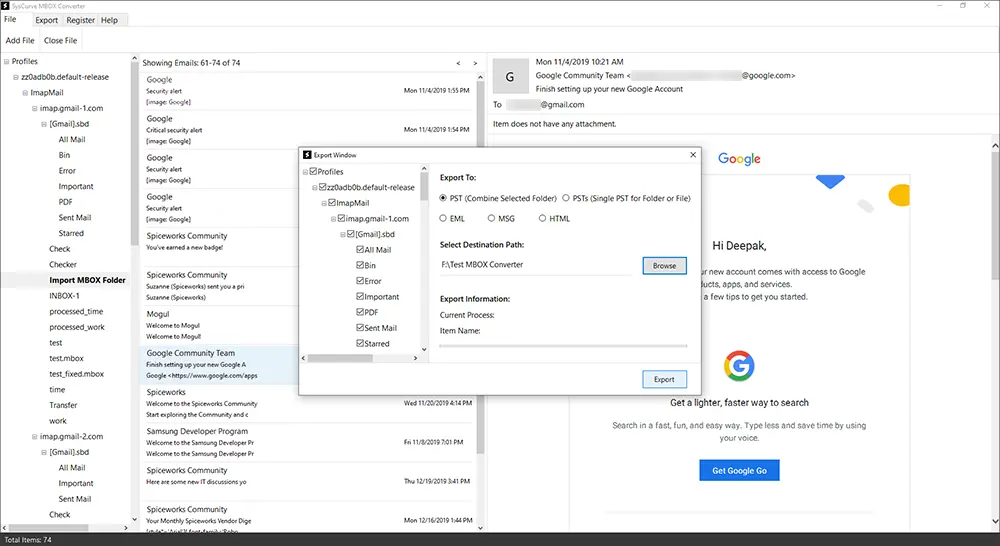
7. Press the ‘Export’ button to initiate the Thunderbird to Outlook conversion.
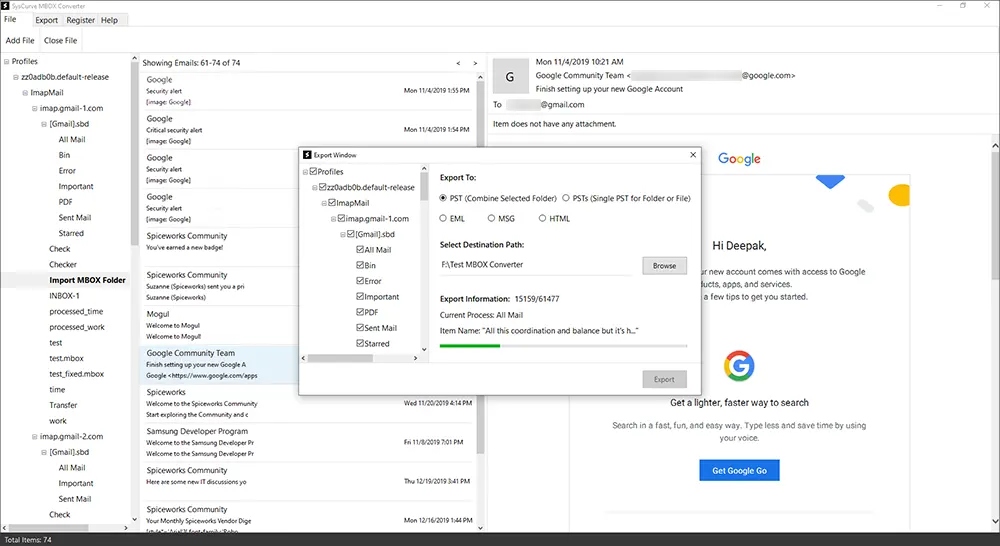
8. After the conversion is complete, click the ‘OK’ button to finish.

Import the PST File into Outlook
Once the Thunderbird to Outlook converter tool confirms that the export is complete, the final step is to import the newly created PST file into Microsoft Outlook.
- Open Microsoft Outlook (the Classic version is recommended for this step).
- Go to File > Open & Export > Import/Export.
- In the Import and Export Wizard, select Import from another program or file and click Next.
- Choose Outlook Data File (.pst) and click Next.
- Click Browse and navigate to the location where the PST file was saved. Select the file.
- Choose the desired options for handling duplicates and click Next.
- Select the folder in Outlook where the data should be imported (usually the top-level account name) and ensure the Include subfolders box is checked.
- Click Finish. The Thunderbird folders and emails will now appear in the Outlook folder list, with their original structure and data intact.
Verification checklist (converter):
- Compare folder count and total items against Thunderbird.
- Spot-check 10 emails for attachments, dates, and formatting.
- Open 2-3 nested folders and confirm hierarchy.
Beyond Emails: A Holistic Migration of Contacts & Calendars
For a complete transition, your address book and calendar must be migrated along with your emails. To make this a comprehensive, one-stop guide, we’ve included dedicated instructions for this vital data, ensuring your entire workflow moves seamlessly to Outlook.
Migrating Your Thunderbird Address Book
Thunderbird allows the address book to be exported into a universal format, CSV (Comma-Separated Values), which Outlook can easily import.
Export Thunderbird Address Book
- In Thunderbird, click the Address Book button in the main toolbar, or navigate to Tools > Address Book.
- With the Address Book window open, click on Tools in its menu bar and select Export...
- In the “Export address book” dialog, a “Save as type” dropdown menu will appear. Select Comma Separated (*.csv) from the list. Give the file a name (e.g., “TB Contacts”) and save it to the Desktop.
Import Thunderbird Address Book in Outlook
- Open Microsoft Outlook and go to File > Open & Export > Import/Export.
- Choose Import from another program or file and click Next.
- Select Comma Separated Values and click Next.
- Click Browse and select the “TB Contacts.csv” file saved earlier.
- Choose how to handle duplicate contacts and click Next.
- In the “Select a destination folder” list, scroll to find and select the Contacts folder within the Outlook account. Click Next.
- Click Finish. The Thunderbird contacts will now be available in the Outlook People or Contacts section.
Migrating Your Thunderbird Calendar
Thunderbird Calendar is built in. You can export calendars as .ics (iCalendar) files and import them into Outlook.
Export the Calendar from Thunderbird
- In Thunderbird, switch to the Calendar view. In the calendar list on the left, right-click the calendar that needs to be migrated and select Export Calendar...
- In the save dialog, ensure the “Save as type” is set to iCalendar Format (*.ics). Give the file a name and save it to the Desktop.
Import the Calendar into Outlook
- Open Microsoft Outlook and switch to the Calendar view.
- Go to File > Open & Export > Import/Export.
- In the wizard, select Import an iCalendar (.ics) or vCalendar file (.vcs) and click Next.
- Browse to and select the .ics file saved from Thunderbird. Click OK.
- Outlook will present the option to Open as New (creating a separate calendar) or Import (merging the events into the primary Outlook calendar). Choose the desired option. The calendar events will now appear in Outlook.
Troubleshooting Common Migration Issues
Here are expert fixes for the most common migration problems.
- IMAP Authentication Fails: This is typically an authentication error. Use Sign in with Google when available. If you see a basic password box, use a 16-digit App Password and ensure 2-Step Verification is active.
- Application Freezes During Drag-and-Drop: This happens when you move too many emails at once. The only manual fix is to drag very small batches, which is impractical for large mailboxes. The recommended solution is to use an automated converter tool.
- Folder Structure Is Lost or Incorrect: This is a known limitation of manual methods. They do not reliably transfer your folder hierarchy. To guarantee your folder structure is preserved perfectly, you must use a dedicated Thunderbird converter tool.
- Emails or Attachments Are Missing: Data loss can occur if a manual transfer is interrupted. You can try re-migrating the affected folders, but to ensure complete data integrity, using a professional converter tool is the most secure solution.
- Cannot Find Import/Export in Outlook: You are likely in New Outlook. Switch to Classic Outlook (see the New Outlook vs Classic box above) to use File > Open & Export > Import/Export.
Thunderbird to Outlook FAQ (2026)
Can I import Thunderbird Local Folders to Outlook?
Yes - but only if you export them (EML) or upload them into an IMAP folder first (IMAP bridge). Local Folders will not sync automatically because they are stored on disk.
Can New Outlook import a PST?
New Outlook can open PST email and you can move/copy mail and folders, but importing from PST using the Import/Export wizard (and importing contacts/calendar from PST) is not supported in new Outlook. Use Classic Outlook for traditional PST import workflows.
Does this keep read/unread status and original dates?
IMAP usually preserves dates and most read/unread flags. EML drag-drop is least reliable; converters are designed to preserve metadata more consistently.
Thunderbird Maildir vs MBOX - does it matter?
Yes. MBOX stores many messages in one file, while Maildir stores each message separately. Most converters handle both, but manual steps differ.
How do I move Thunderbird mail into a Microsoft 365 mailbox?
If the mail is already on IMAP (Gmail/Outlook.com/Office 365), add the same account in Outlook and let it sync. For Local Folders, use EML export or a converter first.
Do I need Outlook installed to create a PST?
For SysCurve PST output, Classic Outlook must be installed on the same Windows PC. If Outlook is not installed, export to EML or MBOX.
Thunderbird to Outlook without Gmail?
Use EML export with ImportExportTools NG or a converter. The Gmail IMAP bridge is optional.
Thunderbird to Outlook without Outlook installed?
You can move mail into an Outlook.com/Microsoft 365 mailbox via IMAP, but creating a PST file requires Classic Outlook on Windows.
Why does Outlook freeze when importing EML?
Large batches can overwhelm Outlook. Import in small batches (50-200), wait for processing, or use a converter for large mailboxes.
Sources (Microsoft, Google, Mozilla)
- Microsoft: Feature comparison between new Outlook and classic Outlook
- Google: Check Gmail through other email platforms (IMAP)
- Google: App passwords
- Mozilla: Thunderbird profile location
- Mozilla: Maildir in Thunderbird
- ImportExportTools NG add-on
Final word
Choose the Thunderbird to Outlook method that matches your mailbox size and where your mail lives. IMAP works for server mailboxes, EML export fits small folders, and converters are best for large Local Folders and hierarchy. Complete PST import/export in Classic Outlook, then switch back to New Outlook if needed. Test with a small sample first, keep backups, and plan enough disk space for exports.